How Many People Fit in a Rome Golf Cart?
Seven, and four operators say so in their own listings. Why that number decides whether private is worth it, and what happens to groups larger than one cart.
Seven. That is the number, and it is unusually consistent for something operators are not obliged to publish.
Four separate Rome operators state it in their own listings, in their own words:
- “The tour operates with 2 golf carts, with a maximum of 7 guests per cart.”
- “Please note that there are 7 seats per vehicle and tours are run with up to a maximum of 2 vehicles and 14 participants.”
- “Enjoy a personalized experience with just 5 to 7 people per group.”
- "…with a maximum of 7 people per cart, which will move like two train cars."
Seven is therefore not one operator’s fleet choice. It is what a Rome tour cart is.
Why the number matters more than it looks
Because it decides whether booking private is worth anything to you — and that is not obvious until you line your party up against it.
Two people. A shared cart means five strangers. Private buys exclusivity and pace and nothing else, for a premium of roughly twenty per cent. A genuine preference rather than a clear answer.
Three or four. The case where private buys the most: enough of you that a shared cart is crowded and conversation is awkward, not enough to fill one on your own.
Five to seven. You fill a cart. A private booking gives you a vehicle you would effectively have had to yourselves anyway — and, more usefully, removes the risk of being split across two carts when the operator runs a second one for other guests.
More than seven. You are in convoy whatever you book. See below.
Note that none of this changes the per-head price: every Rome cart tour is quoted per person, private included, so a bigger group does not make private cheaper each.
What happens above seven
Operators handle larger parties by running two or three carts together. One listing describes them moving “like two train cars”; another caps its operation at two vehicles and fourteen participants.
The practical consequences are worth planning for.
The guide can only be in one cart. The others get a driver. That is the single biggest difference, because commentary then happens at stops rather than continuously — and the between-monument stretches, where a guide fills the gaps, are quiet in the second vehicle.
Your party may be split. Ask how they allocate. Families usually want children with a particular adult, and that is easier to arrange before the morning than during it.
Ask how many vehicles will run. Tours stating a maximum of two vehicles and fourteen participants are the clearest about this. If a listing is vague and your group is nine or ten, message the operator through the booking platform before you book.
Families and the seven-seat rule
A family of four or five sits neatly under the limit, which is the most comfortable position to be in: you have the vehicle to yourselves on a private booking without paying for empty seats — because the price is per person either way.
Two further points that matter with children specifically.
Pace, not privacy, is the real argument. A shared tour runs to a schedule built around seven people, and children do not reliably cooperate with that. On a private cart you can cut a stop short or linger at one that has caught them.
Check minimum ages and child rates, which vary by operator and are not consistent across the shelf.
Getting in and out is its own consideration
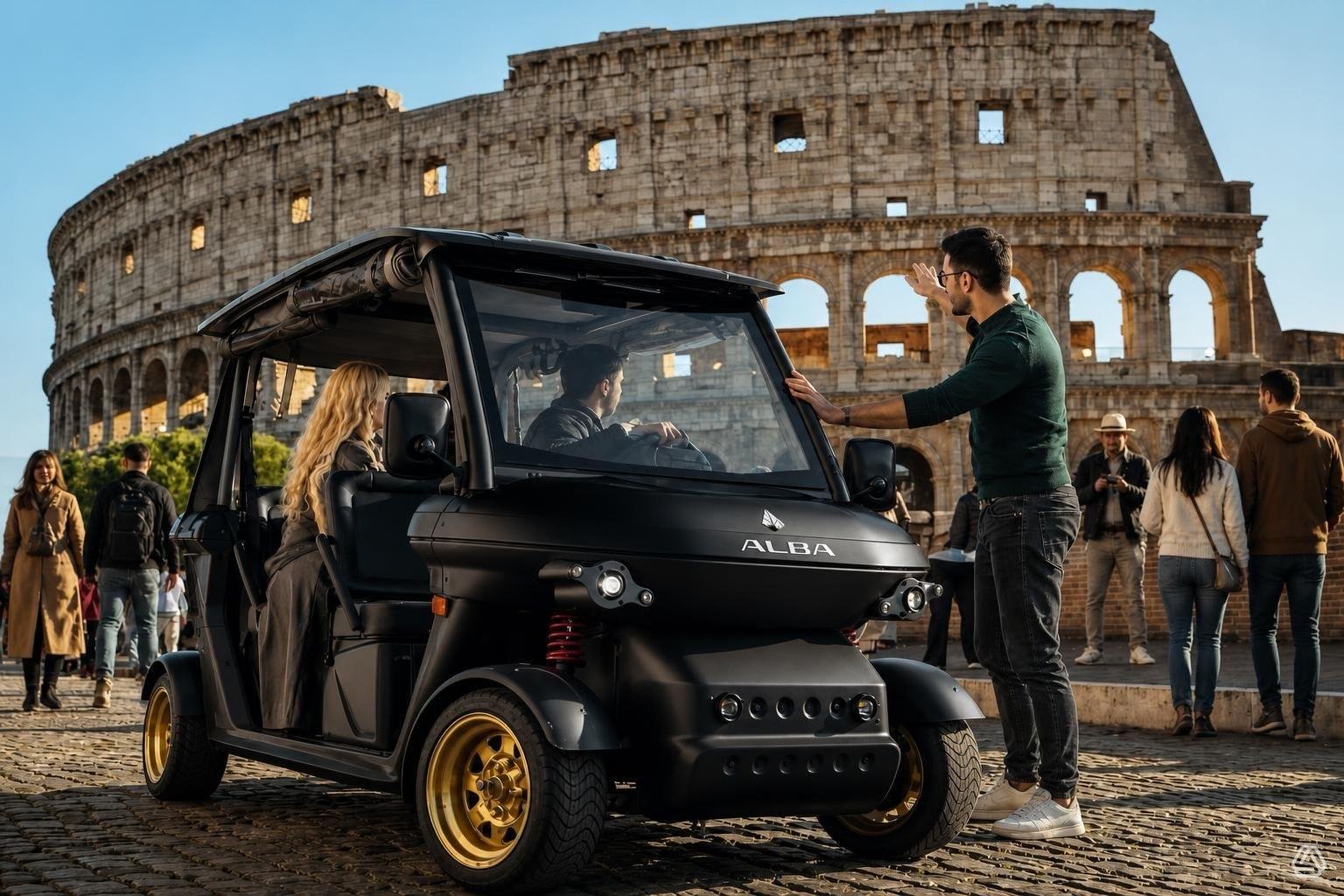
Seven seats in a golf cart means a low, open vehicle with bench seating and a step up rather than a door.
For most people that is fine and part of the appeal. For anyone with restricted mobility — often the reason a cart was chosen in the first place — the repeated getting in and out at each stop is a real demand, separate from the walking the cart is saving.
If that is the issue, look for tours with fewer, longer stops rather than a fast highlights sweep, and ask the operator directly. Some run accessible or adapted variants; the only way to know is to ask, because inclusion lists rarely say.
The weather sits in the seats with you
Rome carts are open-sided. That is why they are pleasant — you are in the city rather than behind glass — and exactly why they are not in rain or a July afternoon.
Operators fit side covers and run in light rain. Three damp hours in an open vehicle is not the day in the photographs. Since these tours carry free cancellation, book and move it if the forecast turns.
Booking for a full cart
If your group is close to seven, book earlier than you otherwise would. You are committing an entire vehicle, and the well-reviewed private tours fill several days out in April to June and September to October.
Free cancellation means the early reservation costs nothing and protects both the slot and the time — and for a group of seven, the time is the harder thing to replace.
A Cart of Your Own
The best-value private cart in Rome runs from about $48 with hotel pick-up included — less than the median shared tour. Rated 4.7/5 by 1,274 verified guests.
Check Availability & Book